- They're all men.
- They can't spell.
- They're obsessed with homeopathy.
- They're predictable.
- They're confusing. Some skeptics are good guys. Some skeptics are bad guys. I can never remember who is which, and have to read another rant about homeopathy or climate change to remind me.
- They've upset the nice people at Glasgow Science Festival. Well that was me actually. But it was their fault. I let slip in a moment of weakness that I don't give a toss about homeopathy.
- They convey none of the wonder of science.
- They repel the scientifically uninformed but keen to learn.
- They've grasped one half of science - that it's analytic and critical - but not the other - that it's creative and constantly surprising.
- They point out stupidity wherever they find it. But no one in the history of the world - not since the first great ape stood tall on the savannah and scanned the horizon for food and women - has ever got suddenly smarter by being told how naive, gullible and brainless they really are.
Wednesday, 17 August 2011
10 problems with skeptics

Sunday, 1 May 2011

Teach the controversy in science
A few days ago I linked from Twitter to an article in Times Educational Supplement Scotland about first-year university biology students who did not believe in evolution.
The last two paragraphs of that article are quotes from an intelligent design spokesman. So I emailed the editor suggesting that an article on science and education in TESS should not be a platform for "people who peddle propaganda and have no interest in science or education."
She replied as follows: "Alastair Noble is a former HM Inspector, and we thought if it was interesting enough to run in the [Edinburgh] science festival, it was worth reporting on."
Now this seems perfectly reasonable. It's what newspaper and magazine editors routinely do in the interests of fairness, when they seek comment from opposing points of view. It's journalistic balance.
But on the same day I received an email from Glasgow Science Festival, saying "I wonder if we should make more of this. It's one vehicle for getting people discussing it. What do you think, should we try and get it talked about more?"
Here's my reply to GSF:
"The problem with any kind of engagement is that it gives them a platform, which allows them to bring very effective PR techniques into play that were first developed for the tobacco companies then later honed and improved for the climate change deniers.
It's a fight in which they are using weapons that scientists and science communicators largely don't understand.
These people give the appearance of rationality while trying to undermine reason as a way of understanding the world. It's a fundamentally and deliberately dishonest approach. So any attempt to engage honestly and openly with them only strengthens their position in the public mind.
It's all about "teach the controversy" which scientists unintentionally support and collude with, whenever we grant them an opportunity to debate with us in public - as do editors when they aim for journalistic balance, when the two sides of a dispute are anything but balanced."
GSF replied that they agreed with all that, but:
"I wasn't really thinking about a public debate or any GSF content that might be used as a platform like this. You have to fight a corner. We thought about this last year when a prominent climate change denier was offering to come to GSF and take part in an event. We decided not to risk it, as it would be hijacked. That's exactly what happened to Roger's event here.
Still, I think GSF should at least engage in some way. He was an HMI for heavens' sake. There's a lot of people and many scientists who will not have seen this TESS article, not know about Curriculum for Excellence and the Scottish Qualifications Authority and maybe we should do something for them - disseminating information, counter arguments, arming people with facts etc that might help and encourage scientists to wake up a bit and lobby SQA and Learning and Teaching Scotland."
So to summarise: The ID people managed to get a small say at an Edinburgh Science Festival event. As a result TESS, the country's leading educational publication, invited them to comment on new research findings in biology education. My own comment on this led Glasgow Science Festival to start thinking about giving more prominence to ID, if only to help scientists counter their ideas and opinions.
That is Teach the Controversy in action.
The last two paragraphs of that article are quotes from an intelligent design spokesman. So I emailed the editor suggesting that an article on science and education in TESS should not be a platform for "people who peddle propaganda and have no interest in science or education."
She replied as follows: "Alastair Noble is a former HM Inspector, and we thought if it was interesting enough to run in the [Edinburgh] science festival, it was worth reporting on."
Now this seems perfectly reasonable. It's what newspaper and magazine editors routinely do in the interests of fairness, when they seek comment from opposing points of view. It's journalistic balance.
But on the same day I received an email from Glasgow Science Festival, saying "I wonder if we should make more of this. It's one vehicle for getting people discussing it. What do you think, should we try and get it talked about more?"
Here's my reply to GSF:
"The problem with any kind of engagement is that it gives them a platform, which allows them to bring very effective PR techniques into play that were first developed for the tobacco companies then later honed and improved for the climate change deniers.
It's a fight in which they are using weapons that scientists and science communicators largely don't understand.
These people give the appearance of rationality while trying to undermine reason as a way of understanding the world. It's a fundamentally and deliberately dishonest approach. So any attempt to engage honestly and openly with them only strengthens their position in the public mind.
It's all about "teach the controversy" which scientists unintentionally support and collude with, whenever we grant them an opportunity to debate with us in public - as do editors when they aim for journalistic balance, when the two sides of a dispute are anything but balanced."
GSF replied that they agreed with all that, but:
"I wasn't really thinking about a public debate or any GSF content that might be used as a platform like this. You have to fight a corner. We thought about this last year when a prominent climate change denier was offering to come to GSF and take part in an event. We decided not to risk it, as it would be hijacked. That's exactly what happened to Roger's event here.
Still, I think GSF should at least engage in some way. He was an HMI for heavens' sake. There's a lot of people and many scientists who will not have seen this TESS article, not know about Curriculum for Excellence and the Scottish Qualifications Authority and maybe we should do something for them - disseminating information, counter arguments, arming people with facts etc that might help and encourage scientists to wake up a bit and lobby SQA and Learning and Teaching Scotland."
So to summarise: The ID people managed to get a small say at an Edinburgh Science Festival event. As a result TESS, the country's leading educational publication, invited them to comment on new research findings in biology education. My own comment on this led Glasgow Science Festival to start thinking about giving more prominence to ID, if only to help scientists counter their ideas and opinions.
That is Teach the Controversy in action.
Thursday, 28 April 2011
St Luke's High School's high achievers
 St Luke's High School, East Renfrewshire is the school that's bucking, by a mile, the obvious correlation in the above chart between attainment and socially advantaged catchment area.
Here's how St Luke's High does it.
Why evolution is not mentioned in the new Scottish Curriculum
A spokesperson from Learning and Teaching Scotland, said: "The use of the word 'evolution' was not avoided for religious reasons or to avoid any particular sensitivities.
"Evolution is addressed through the biodiversity and interdependence element in science, which deals with survival of the species and adaptation to the environment. This is complemented by the inheritance line of development which develops an understanding of how organisms develop and pass on genetic information to the next generation."
From Times Educational Supplement Scotland 24 April 2009
"Evolution is addressed through the biodiversity and interdependence element in science, which deals with survival of the species and adaptation to the environment. This is complemented by the inheritance line of development which develops an understanding of how organisms develop and pass on genetic information to the next generation."
From Times Educational Supplement Scotland 24 April 2009
Thursday, 10 March 2011
Smiling sweetly
We writers don’t get out much and I’ll tell you why. Bad things happen when we do.

As Jean McLeish tucks into a little haggis on a stick, which the waitresses at Edinburgh’s National Gallery keep pushing on us, like they're on commission, I can’t help thinking of all the food this woman snatched from my children’s lips. Or would have done, if they weren’t both well into their twenties at the time.
I’d been writing freelance features for TES Scotland for five years when Jean appeared out of nowhere, with great ideas and well-crafted stories. The first line of hers I ever read sticks in my mind: “Chloe's tooth diamond is a twinkling distraction amid the building site paraphernalia of paint, ladders and hard hats”.
“Hey, that’s great,” I thought. “She’s got to go.”
Five years later Jean is still there, turning out high quality features every week. “Did you enjoy the educational debate,” I smile sweetly and act civilised.
“It was fine,” Jean replies. “Although I’m more interested in people than policy. Did you?”
“Didn’t make it in time,” I tell her. “Got bumped by a bus, detained by the surly, slow-writing driver, then ran round and round the National Gallery for ages, searching for a way in. Finally realised it was down here in the Gardens but the big gate was padlocked. I had to scramble over the railings to get in.”
“Good heavens, how awful,” Jean sympathises and steps back a pace. “I’m surprised you’re not even more sweat-stained and dishevelled.”
An elegant woman in a black dress floats past. “Thanks for coming, Douglas,” says the new editor. “No problem, Gillie,” I lie fluently.
The occasion is the relaunch of TESS as a magazine and the formal handover from Neil Munro, editor for ten years, to Gillie Macdonald. It’s a chance to hear her vision for the future and meet writing colleagues I never see.
Among the tall pillars and vol-au-vents, I hunt down Gregor Steele, whose fortnightly columns are funny and insightful. “Where do you get your ideas?” I ask the former physics teacher, unoriginally. “Life,” he tells me. “And physics, which is full of metaphor.”
I find Julia Belgutay, whose weekly column capturing kids’ talk makes me laugh out loud. For example: “She bought a book because she thought it was about Lance Armstrong, but it was about bike saddles.”
“I get good stuff from young people because inside my head I’m the same age as they are,” Julia tells me.
I meet news reporter Henry Hepburn, tall, slim, friendly and the official TESS tweeter, Jackie Cosh, who manages to write while bringing up four kids, and Chris Small, appointed to the News team from Children in Scotland. We share our liking for Jonathan Sher, their distinguished but genial research director, a committed children’s advocate from North Carolina.
Gillie’s talk gets off to a great start among the two Gaelic speakers at the gathering, when she tells a joke in the language of her father, author Finlay J Macdonald. A quick translation allows us southerners to join in the jollity. Then she gets serious.
The format of TESS might have changed, she says, but it’s still all about up-to-the-minute education news. “We’ve a new four-page focus that looks in detail at one topic a week. We’re taking all the expertise of our education correspondents – there’s no specialist team like it in Scotland – and providing depth now, to go with the range.”
The features section, which highlights good practice around the country, remains. “We see it as a crucial part of our role, particularly when schools don’t have money for CPD.”
Online teaching resources compiled over the years by TES UK will be plundered each week. “There are thousands of them, all free. We will take the best of those and tailor them for our Scottish readers.”
Comment, discussion and debate will be encouraged: “Don’t just read an article and think about it. Write in and tell us. You can have 900, 450 or 300 words, depending where we put it. We want to hear from you.”
Then there’s the most interesting section for many readers. “TESS used to be the place to go for jobs in education. It is again. Classroom teachers, headteachers, independent schools – they’re all there now in one place, at the back of the magazine.”
She recalls recent publishing industry awards: “2008 business and professional magazine of the year: Times Educational Supplement Scotland. 2009 editor of the year: Neil Munro. 2010 features writer of the year: Emma Seith.
“That is a track record we won’t throw away,” Gillie concludes. “I am excited to see what we can do in 2011.”
As distinguished guests and ink-stained scribblers sidestep the haggis-ball pushers and disperse, I say goodnight, find my car, take a look at the damage inflicted by the bus, decide it’s superficial and drive off into the night. It was a lovely evening in the end.
I got to get out more.

As Jean McLeish tucks into a little haggis on a stick, which the waitresses at Edinburgh’s National Gallery keep pushing on us, like they're on commission, I can’t help thinking of all the food this woman snatched from my children’s lips. Or would have done, if they weren’t both well into their twenties at the time.
I’d been writing freelance features for TES Scotland for five years when Jean appeared out of nowhere, with great ideas and well-crafted stories. The first line of hers I ever read sticks in my mind: “Chloe's tooth diamond is a twinkling distraction amid the building site paraphernalia of paint, ladders and hard hats”.
“Hey, that’s great,” I thought. “She’s got to go.”
Five years later Jean is still there, turning out high quality features every week. “Did you enjoy the educational debate,” I smile sweetly and act civilised.
“It was fine,” Jean replies. “Although I’m more interested in people than policy. Did you?”
“Didn’t make it in time,” I tell her. “Got bumped by a bus, detained by the surly, slow-writing driver, then ran round and round the National Gallery for ages, searching for a way in. Finally realised it was down here in the Gardens but the big gate was padlocked. I had to scramble over the railings to get in.”
“Good heavens, how awful,” Jean sympathises and steps back a pace. “I’m surprised you’re not even more sweat-stained and dishevelled.”
An elegant woman in a black dress floats past. “Thanks for coming, Douglas,” says the new editor. “No problem, Gillie,” I lie fluently.
The occasion is the relaunch of TESS as a magazine and the formal handover from Neil Munro, editor for ten years, to Gillie Macdonald. It’s a chance to hear her vision for the future and meet writing colleagues I never see.
Among the tall pillars and vol-au-vents, I hunt down Gregor Steele, whose fortnightly columns are funny and insightful. “Where do you get your ideas?” I ask the former physics teacher, unoriginally. “Life,” he tells me. “And physics, which is full of metaphor.”
I find Julia Belgutay, whose weekly column capturing kids’ talk makes me laugh out loud. For example: “She bought a book because she thought it was about Lance Armstrong, but it was about bike saddles.”
“I get good stuff from young people because inside my head I’m the same age as they are,” Julia tells me.
I meet news reporter Henry Hepburn, tall, slim, friendly and the official TESS tweeter, Jackie Cosh, who manages to write while bringing up four kids, and Chris Small, appointed to the News team from Children in Scotland. We share our liking for Jonathan Sher, their distinguished but genial research director, a committed children’s advocate from North Carolina.
Gillie’s talk gets off to a great start among the two Gaelic speakers at the gathering, when she tells a joke in the language of her father, author Finlay J Macdonald. A quick translation allows us southerners to join in the jollity. Then she gets serious.
The format of TESS might have changed, she says, but it’s still all about up-to-the-minute education news. “We’ve a new four-page focus that looks in detail at one topic a week. We’re taking all the expertise of our education correspondents – there’s no specialist team like it in Scotland – and providing depth now, to go with the range.”
The features section, which highlights good practice around the country, remains. “We see it as a crucial part of our role, particularly when schools don’t have money for CPD.”
Online teaching resources compiled over the years by TES UK will be plundered each week. “There are thousands of them, all free. We will take the best of those and tailor them for our Scottish readers.”
Comment, discussion and debate will be encouraged: “Don’t just read an article and think about it. Write in and tell us. You can have 900, 450 or 300 words, depending where we put it. We want to hear from you.”
Then there’s the most interesting section for many readers. “TESS used to be the place to go for jobs in education. It is again. Classroom teachers, headteachers, independent schools – they’re all there now in one place, at the back of the magazine.”
She recalls recent publishing industry awards: “2008 business and professional magazine of the year: Times Educational Supplement Scotland. 2009 editor of the year: Neil Munro. 2010 features writer of the year: Emma Seith.
“That is a track record we won’t throw away,” Gillie concludes. “I am excited to see what we can do in 2011.”
As distinguished guests and ink-stained scribblers sidestep the haggis-ball pushers and disperse, I say goodnight, find my car, take a look at the damage inflicted by the bus, decide it’s superficial and drive off into the night. It was a lovely evening in the end.
I got to get out more.
Friday, 4 February 2011
Sally Bercow
I like the photograph. But I'd have cropped it much more tightly, like this:
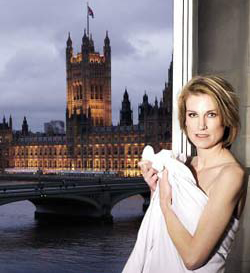
It makes a far better image.
But being less revealing, it's not as effective in sticking two fingers to the fogeys.

It makes a far better image.
But being less revealing, it's not as effective in sticking two fingers to the fogeys.
Subscribe to:
Posts (Atom)